
10 Things to Know Before You Go to Sal, Cape Verde
Cabo Verde is becoming an increasingly popular destination for travellers looking for sunshine, beautiful beaches, culture, a relaxed pace and something a little different.
After finally making it to Cabo Verde myself, six years after I had originally planned to visit, I came away with a much better understanding of what the destination actually offers and a few practical things I think are worth knowing before you go.
Some of this information is readily available through official travel guidance, which I've brought together here. Other details are the little things you only really appreciate once you've actually been.
So, if Cabo Verde is on your travel list, here are 10 things I think you should know before you go.
1. Cabo Verde Is an Archipelago: Choose Your Island Carefully
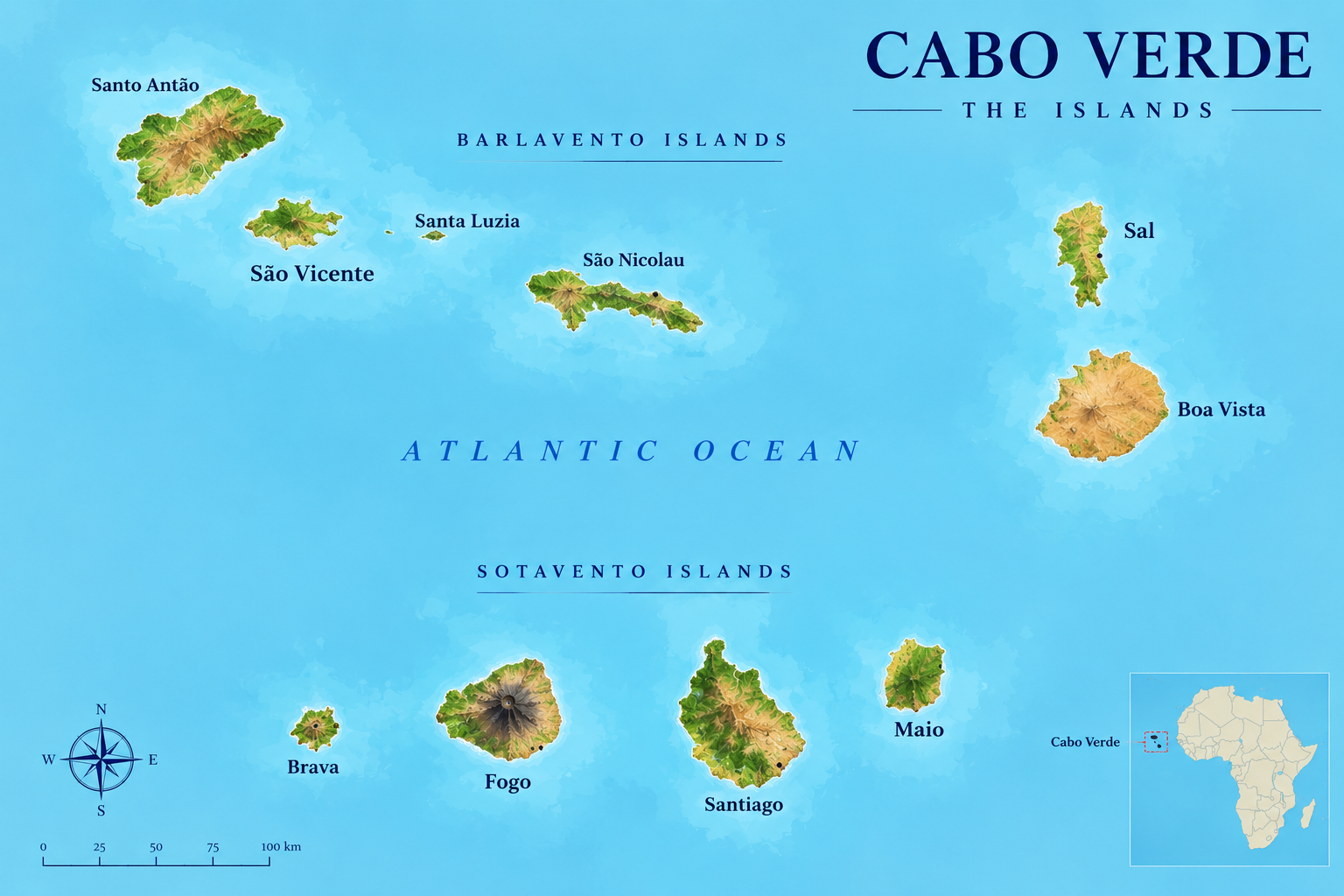
Cabo Verde is an archipelago of ten volcanic islands in the central Atlantic Ocean, just off the west coast of Africa. It’s also a member of the Economic Community of West African States (ECOWAS).
Nine of the ten islands are inhabited, with Santa Luzia being the only uninhabited island. Praia, on the island of Santiago, is the country's capital and largest urban centre.
Portuguese is the official language, although Kriolu is spoken widely throughout the islands
Cabo Verde isn't one holiday experience.
Each island has its own landscape, character and appeal.
Sal is one of the most popular choices for travellers seeking sunshine, beautiful beaches, water sports, and a relaxed holiday. This is the island I chose for this trip.
Boa Vista is another popular choice for beach lovers, with long stretches of sand, dunes and a strong resort scene.
Santiago, home to Praia, the island's capital, offers something quite different, especially if you're interested in history, culture, and experiencing more everyday Cape Verdean life.
São Vicente is widely known as the cultural heart of Cabo Verde and is often referred to as the musical capital of the archipelago. Mindelo, in particular, is known for its music, nightlife and cultural scene.
Santo Antão is the island I’d go for: hiking, dramatic mountains, valleys, and if nature is your thing.
Fogo is famous for its volcanic landscape and Mount Fogo, while Maio is known for its quieter character and beautiful beaches.
Then you have São Nicolau and Brava, which offer a much quieter experience, and Santa Luzia, the only uninhabited island.
So before you simply search for “Cabo Verde holidays”, think about the kind of experience you're actually looking for.
Do you want a beach holiday? Culture? Adventure? Hiking? Nightlife? Or perhaps a mixture of it all?
For this trip, I chose Sal Island, and within Sal, I stayed in Santa Maria, which is the main tourist town.
Sal Island’s capital is Espargos, where you get to experience more of the everyday Cabo Verdean life on Sal.
2. Before You Fly: Entry Requirements
Let's get the practical stuff out of the way.
Your entry requirements depend on the passport you are travelling with, so make sure you check the rules that apply to your nationality before you travel.
Travelling on a Nigerian passport 🇳🇬
Nigerian passport holders can currently visit Cabo Verde without a visa for stays of up to 90 days.
Nigeria is also an ECOWAS member state, and several other West African countries currently have visa-free access to Cabo Verde for stays of up to 90 days, including Ghana, Senegal, Sierra Leone and The Gambia.
Travelling on a British passport 🇬🇧
British citizens can currently visit Cabo Verde without a visa for stays of up to 30 days.
Travelling on a US passport 🇺🇸
US passport holders can currently visit Cabo Verde without a visa for stays of up to 30 days.
Important: Visa requirements can change. The information above is intended as a helpful starting point, but your passport's current entry requirements should always be verified with the relevant official authorities before travelling.
EASE: A Must!
This is important!
Even if you are travelling from a country that is visa-exempt, you MUST complete the required traveller pre-registration through Cabo Verde's EASE platform before travelling. The current guidance states that this should be completed at least five days before arrival, with the Airport Security Tax (TSA) paid through the EASE platform where applicable.
I completed mine online before leaving the UK, and I suggest you do the same before you travel; it’s easy and stress-free, knowing that when you arrive there will be no issues.
Save the confirmation on your phone. Take a screenshot. And yes, I would print it out too.
I like having important travel documents both digitally and physically when I'm travelling internationally. There is nothing worse than needing something when your phone battery is at 3%.
The current UK government guidance also states that from 1 July 2026, travellers who arrive without completing the required pre-registration or cannot show proof of it will have to pay double the TSA fee at border control.
My advice? Just do it before you go. It's easier.
Official Cabo Verde EASE Registration:
https://www.ease.gov.cv/
3. Cash Is King in Cabo Verde
The official currency is the Cape Verdean Escudo (CVE), although euros are widely accepted, particularly in tourist areas.
Cards are accepted widely across Santa Maria. You'll find plenty of bars, restaurants, shops and other establishments that accept them, and there are ATMs where you can withdraw cash.
But honestly?
Cash is definitely king in Cabo Verde.
I would recommend carrying some cash with you throughout your stay rather than relying entirely on your card.
ATM charges can be reasonable, although what you actually pay will depend on your own bank and its foreign exchange or conversion fees.
So yes, you can use your card. Yes, there are ATMs. Yes, euros are widely accepted.
But have cash on you.
I found that having cash made life much easier, particularly for smaller purchases, taxis and places where cards weren't an option.
4. Understand the Santa Maria Vibe
If you've chosen Sal, there's a good chance you'll spend some of your time in Santa Maria, so it's worth understanding the layout and atmosphere.
Santa Maria is where you'll find much of the island's tourist buzz, with restaurants, bars, cafés, shops and plenty of places to eat and drink.
The main strip runs alongside the beach, so you can quite easily go from a day beside the Atlantic to getting showered and dressed for dinner and drinks in the evening.
And then there's the beach.
Santa Maria Beach is long, sandy and beautiful, with lively areas where you'll find beach clubs and activities, as well as quieter stretches where you can simply sit down, read your book and do absolutely nothing.
If you're staying in one of the larger resorts, many are situated on the outskirts of Santa Maria rather than directly in the centre, but they are not far from Santa Maria, so if you're staying in a resort, don't feel like you're missing out because you're not directly on the strip. You can easily head into Santa Maria when you want some atmosphere.
And there is atmosphere.
Cape Verdeans are warm, lively, friendly and sociable. Music is an important part of life, and there is a very relaxed energy to the island.
You'll often hear the phrase:
“Cabo Verde, No Stress.”
5. Be Prepared, There Are Dogs
Now, this is one of those things I don't remember seeing mentioned online before I went.
There are dogs.
You know how, when you are in Istanbul, you are guaranteed to see plenty of cats. You'll see a lot of dogs around Santa Maria. Most of the ones we came across were friendly and very chilled. They're part of the landscape, and you'll see them wandering around the town and surrounding areas.
I'm not mentioning this to scare you.
It's simply one of those little details I think is useful to know before you arrive so you are prepared, especially if you are not used to dogs.
6. Prepare For The Weather
Sal is a dry, arid island, so don't arrive expecting lush tropical scenery. The landscape is raw and open, with sandy beaches, rocky terrain and very little natural vegetation. In some parts, it has an almost lunar-like quality, with its barren terrain and wide open spaces.
When I visited in June, it was very, very hot, particularly around midday. But don't let the heat fool you into thinking you'll never need an extra layer.
The wind is very much part of Sal too. You're surrounded by the Atlantic, and while we didn't experience much wind during the day on our June visit, it became much more noticeable in the evenings and later at night. After midnight, you could really hear it.
So pack for both: light, breathable clothes and sunscreen for the day, but bring a shawl or light jacket for the evenings. You may not need it every night, but you'll be glad you packed it when the Atlantic wind picks up.
7. Portuguese Is Official, But You'll Hear Kriolu Everywhere
Portuguese is the official language of Cabo Verde, but Kriolu, or Cape Verdean Creole, is the language you'll hear spoken throughout the islands.
I loved hearing it.
Because Sal attracts so many international visitors, you'll find that a lot of people working in tourism understand or speak English. Taxi drivers, restaurant staff, servers and people working in tourist establishments generally had no problem communicating with us.
But if you do find yourself having a language barrier, don't panic.
Google Translate is your friend.
And one of my favourite travel hacks, particularly when I'm somewhere where menus aren't in English, is Google Lens.
Take a picture of the menu and let your phone translate it for you.
Simple!
8. Stay Connected and Know How to Get Around
Another thing I would recommend sorting before you leave is your mobile data.
The eSIM we used in Cabo Verde was JamboSim, and it was fantastic. We paid $12 for 5GB of data, valid for 30 days. We were in Sal for seven days and still had data remaining when we came home, so it was more than enough for our trip.
It was affordable, reliable and meant we could stay connected without having to worry about finding a local SIM when we arrived. Even better, you can install your eSIM before you travel, so once you land, you're connected and ready to go.
Get connected with JamboSim → JamboSim eSIM
Affiliate link: I may earn a small commission if you purchase through this link, at no extra cost to you.

Getting around Santa Maria
If you're staying in Santa Maria, you'll probably find yourself walking more than you expect.
We took taxis, particularly at night, when we'd been out all day, were tired or simply couldn't be bothered to walk home after dinner.
But honestly, most of the time we'd say:
“Let's get a taxi.”
And then we'd start walking and realise we were already halfway there.
Santa Maria is relatively compact and very walkable, depending on where you're staying and where you're going.
Taxis are readily available, and we didn't find that we needed to use a particular taxi app. You can simply flag one down.
From our experience, journeys within Santa Maria were generally around 250–300 CVE, depending on where we were going.
If you're travelling outside the immediate Santa Maria area, expect to pay more. Around 500 CVE is a useful ballpark for some journeys, although fares depend on the destination and time of travel.
From Sal Airport to Santa Maria
The taxi fare from Sal Airport to Santa Maria is generally around 2,000–2,200 CVE, which works out at roughly €15–20, depending on the exchange rate.
Personally, I'd budget €20.
It's worth checking whether your hotel, apartment or booking platform offers an airport transfer. Arranging this in advance can make your arrival much easier.
9. Come Hungry: Santa Maria Has Something for Everyone
I heard a lot of people say the food in Cabo Verde was not good, bland and had no variety. I realised that a lot of that information was coming from people staying in the resorts.
The food scene in Santa Maria is varied, relaxed and very much geared towards enjoying yourself.
You'll find Cape Verdean dishes alongside Portuguese influences, West African cuisine, Italian restaurants, pizza, cafés, a lot of seafood, and grilled meat.
Fresh fish is definitely a thing.
We had catch of the day more than once, along with tuna, grilled fish, fish bites, prawns and calamari.
Being on an island in the Atlantic, my sister and I had already decided:
We're in Cabo Verde. We're by the sea. We're eating seafood.
Fresh tuna was noticeably much more affordable than I'm used to seeing in the UK. A tuna steak that could easily cost considerably more back home was available for around €12–€15 or sometimes less, depending on where we ate. A lot of the grilled fish and meat dishes we had came with rice, chips and vegetables or salad.
We also tried cachupa, one of Cabo Verde's best-known traditional dishes.
The food we experienced in Santa Maria was delicious, but I'd say the more tourist-facing restaurants tend to serve a mixture of international and Cape Verdean-influenced dishes. If you want to explore more local food, I'd definitely recommend wandering a couple of streets behind the main tourist strip.
That's where you'll find smaller local restaurants and cantinas serving more traditional dishes, often at more affordable prices.
On the main strip, you'll find plenty of restaurants to choose from, and if you're staying for a week, you could genuinely eat somewhere different every evening.
We also enjoyed breakfast at Papaya, and there are lovely cafés and smaller spots dotted around Santa Maria if you fancy coffee, pastries, brunch or something light during the day.
And then there's the drinks.
Caipirinhas.
Oh, they were dangerous (in a good way 🤭)
They're strong, refreshing and, depending on where you go, surprisingly affordable. We found them for around €4–6.
10. Don't Overplan Sal
If I could give you one piece of advice about visiting Sal, it would probably be this:
Don't overplan it.
Sal is somewhere you can actually permit yourself to slow down.
You can spend the morning at the beach, have lunch, wander around Santa Maria, go back to your accommodation, get dressed and head out for dinner. And if you want a little adventure, there is plenty of that too.
I'd recommend doing an island tour during your stay. It's an easy way to see some of Sal's well-known sights in one day without having to organise every stop yourself. Once you've done it, you can spend the rest of your trip choosing what you actually want to do rather than feeling like you have to fill every day with excursions.
And Sal isn't just about lying on the beach.
You can go snorkelling or scuba diving, take a boat trip or jet ski, try surfing or kitesurfing, visit Kite Beach and Shell Beach, or even try something a little more unexpected, like the zip line or the Giant Swing.
Or simply sit on the beach.
That's the beauty of Sal.
For me, it's primarily a relaxing destination, but there's enough adventure, food, culture and nightlife to give you plenty of options when you want to do more.
We stayed in an Airbnb and spent plenty of time simply switching off. We'd pay for sun loungers or spend time at a beach club, enjoy the clear blue skies and Atlantic water, then head back, get ready and go out for the evening.
And if you're staying in a resort, I'd definitely encourage you to come out into Santa Maria at least once or twice during your stay.
The town really comes alive in the evening. Have dinner. Have a drink. Listen to the music. Wander around and see where the night takes you.
You don't have to do it every night.
But I think experiencing Santa Maria after dark is part of experiencing Sal.
And this is where my approach to intentional travel comes into play.
Before you start booking every excursion you can find, ask yourself:
How do I actually want to feel on this trip?
Maybe you don't need another holiday where you're exhausted by the time you get home.
Maybe you need sunshine. A beautiful beach. A good book. A lovely meal. A little adventure. A night out.
Or perhaps, like me, you need a mixture of all of it.
That's the point of intentional travel.
What Should You Pack for Sal?
The answer depends on you, but I packed loads of swimwear because that's what I wanted to wear during the day.
Swimwear, cover-ups, shorts, sandals, easy.
It's a hot country, and the general dress code around Santa Maria is relaxed and casual.
Then, in the evening, if you want to dress up a little for dinner or drinks? Absolutely do it. I certainly did.
Final Thoughts
Cabo Verde surprised me.
Not because I didn't expect it to be beautiful. I did.
But because once I was actually there, I understood that its appeal isn't just the beaches.
It's the combination.
The sunshine, the sea, the relaxed pace, the music, the food, the people and the evenings.
It's being able to spend half a day doing absolutely nothing and then get dressed up and have a brilliant night out.
It's a little bit indulgent without needing to be overly formal.
And I think that's one of the reasons I enjoyed Sal so much.
You can have your beautiful beach, your good restaurant, your cocktail, your adventure, your local experience, your quiet afternoon, your book and your night out.
And then you can wake up tomorrow and do absolutely nothing.
No stress.
That's Cabo Verde.
And if you're still deciding what kind of trip you actually need right now: Take the WorldwidEmpress Travel Quiz → Here
Because before you decide where to go, I think it's worth asking yourself: What do I actually want from this trip?
And when you're ready to turn that travel dream into something real, explore the Ultimate Manifestation Travel Planner & Journal.
Visualise it. Write it down. Plan it. Bring it to life.
WWE Tip: I always recommend checking the official entry requirements again shortly before travelling, even if you've already done your research. Rules can change. Entry requirements can change, so please recheck the current information before you travel.
Cabo Verde EASE — Official Traveller Pre-Registration
